

Why Delivery Rates of WhatsApp Marketing Notifications Are Low
Many businesses are encountering WhatsApp failures with error codes 131026, 1026, 131049, or 130472.
According to WhatsApp’s official policy, they now limit marketing template messages across all businesses to enhance user experience. Messages deemed less likely to be read will fail delivery.
These restrictions only affect new marketing conversations—ongoing conversations remain unaffected. Meta has implemented these measures specifically to protect user experience, which is why your WhatsApp marketing notifications may be failing with these error codes.
Common errors thrown by WhatsApp
Given below are some of the common errors that you might encounter while trying to send out a WhatsApp campaign.
-
Marketing Template Limit Exceeded
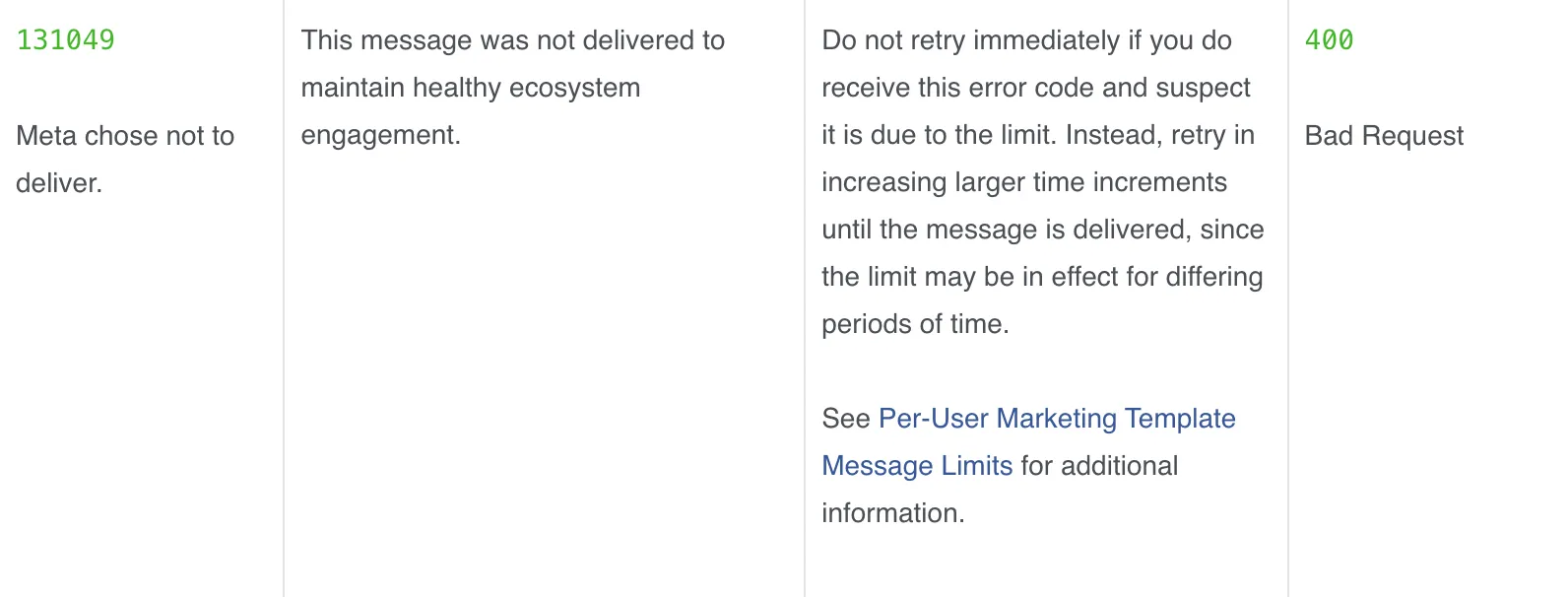
- If you send over 2 marketing messages to a user within 24 hours, you will receive this error message. You will not be able to send the next message until they reply.
- If a marketing template message is not sent due to per-user marketing template limit enforcement, you will see the following error code and message
- Error code - 131049 (for Cloud API) or 1026 (for On-Premises API)
- Error message - This message was not delivered to maintain healthy ecosystem engagement. In order to maintain a healthy ecosystem engagement, the message failed to be delivered.
- Learn more about WhatsApp’s Per-User Marketing Template Message Limits
- How to resolve this - WhatsApp’s help documentation suggests that if you encounter this error, it is ideal to refrain from immediately sending further messages. This could lead to another error as the limit might still be in place. You can attempt to send the messages again, by gradually increasing the time gap, until all messages are successfully delivered.
-
Recipient under integration experiment

- WhatsApp is running an experiment where 1% of users will not receive any marketing messages from businesses unless a chat already exists between them.
- You’ll face this error if you try to send messages to such users. If you send a marketing template message to a customer who is part of the experiment group, your message will not be sent and you will not be billed for it since no conversation was created.
- Instead, you will receive the following error code and message
- Error code - 130472
- Error message - Message was not sent as part of an experiment.
- Learn more about WhatsApp Experiments.
- How to resolve this - You can reach out to them outside WhatsApp and ask them to initiate a WhatsApp chat with you so you can resend the message to them.
-
Message Undeliverable - You will receive an error code 131026 with the message ‘Message Undeliverable’ when one of the below condition is met.
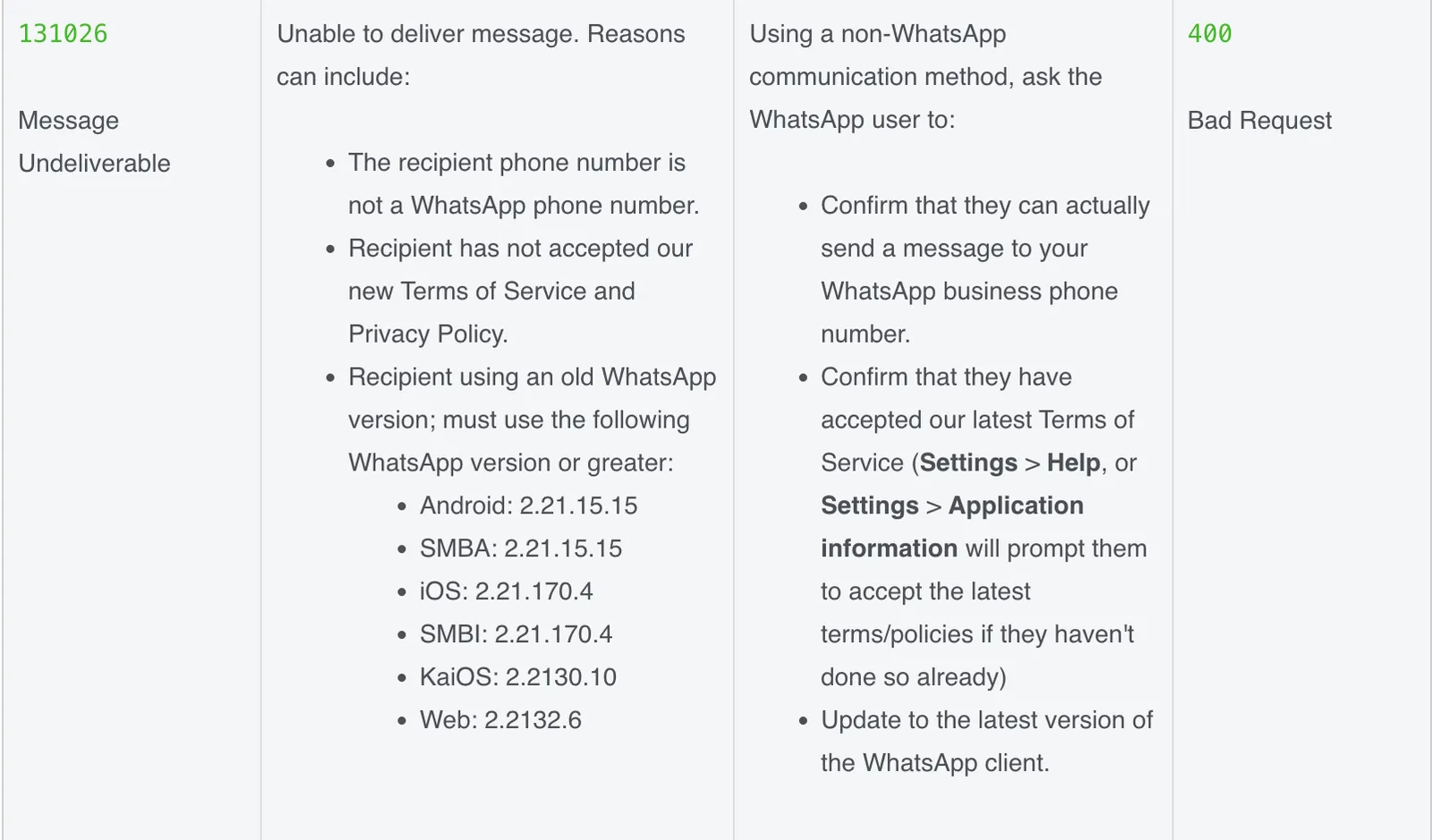
- The recipient phone number is not a WhatsApp phone number.
- Recipient has not accepted our new Terms of Service and Privacy Policy.
- Recipient using an old WhatsApp version
-
Recipient isn’t receiving messages from you right now – You’ll get this error if the recipient has blocked the number you are currently using to send WhatsApp messages.
-
Integration Service Rate limit exceed – You’ll get this error if you’ve exceeded the WhatsApp sending limit.
What Happens if a Template Is Recategorized After Approval?
Meta may periodically update a template’s category if its content better matches a different use-case (for example: UTILITY → MARKETING or MARKETING → AUTHENTICATION).
Pricing Changes
- Billing immediately follows the new category’s conversation rate.
- Future conversations triggered by that template are charged at the new category price.
- Historical conversations remain billed at the original category (no retroactive adjustments).
Delivery Behavior Changes
- Delivery eligibility rules update to match the new category.
- Example: Marketing templates require an open marketing window / opt-in eligibility.
- Message reach and delivery rates may increase or decrease depending on the category rules.
- If a template moves into Marketing, it becomes subject to stricter engagement and frequency controls.
Important: Recategorization does not break the template or require re-approval — but it can affect both cost and deliverability, so monitoring category status is recommended.
How Meta Assigns Categories
Templates can be reclassified into a different category after submission if Meta determines the content better fits another use-case.
- Meta automatically analyzes the message content and assigns the final category using internal classifiers.
- Approved templates may be re-evaluated later and updated again.
- A template submitted as Utility may be approved or later changed to Marketing, or vice versa, depending on how the message reads.
Important: There is no checklist that guarantees approval. In practice, this behaves like a black box — you adjust wording and observe results.
Meta categorizes templates based on the purpose of the message as experienced by the user, not your internal workflow.
Meta Template Categories (Detailed)
Utility — Expected service notifications
Utility messages inform the user about something related to an existing account, transaction, or request they already made. They are status updates, not opportunities.
WhatsApp evaluation logic
Utility templates generally:
- Are non-promotional
- Relate to a specific user or transaction
- Are triggered by a user action, account state, or request
If the message helps the user understand their situation → Utility
Reference examples
- ₹4,200 debited from A/C ending 4582.
- EMI due on 12 Feb.
- KYC pending for verification.
- Loan application approved.
- Payment failed for bill #8842.
- Refund processed.
- Auto-debit scheduled.
These describe account state, not choices.
Marketing — Decision influencing messages
Marketing messages encourage a user to act, explore, or choose.
If the message helps the user make a decision, it is Marketing.
This applies:
- Even if relevant
- Even if helpful
- Even if the user opted in
WhatsApp evaluation logic
Anything that:
- Promotes
- Suggests
- Recommends
- Nudges
- Encourages action
is categorized as Marketing.
Reference examples
- You are eligible for a ₹50,000 loan.
- Increase your credit limit today.
- Upgrade to a premium card.
- Invest in our FD plan.
- Activate cashback offer.
- Pay now to avoid a penalty.
- Complete KYC to unlock benefits.
These influence behaviour, not just inform.
Authentication — Identity verification only
Messages used only to verify the user’s identity.
Anything beyond verification moves it out of Authentication.
Strict rules
- OTP only
- No links
- No media
- No promotional text
Examples
- 482193 is your verification code.
- Use 884221 to reset your password.
Why wording matters (same situation, different category)
This shows how small persuasion changes the category.
Patterns Commonly Seen in Utility Classifications
Meta’s categorization is not rule-based and cannot be predicted with certainty. However, templates approved as Utility frequently share these patterns:
- The message completes or confirms something the user already initiated.
- Information is personalized to the specific recipient (order, account, booking, request).
- The communication would reasonably be expected by the user at that moment.
- Content stays informational rather than persuasive.
- Optional elements (links or buttons) support the transaction rather than discovery.
Common structural characteristics observed
- Clearly anchored to a user action.
- Example: “You’re receiving this because you enabled account alerts.”
- Includes concrete reference details such as:
- ID / reference number
- Date
- Amount
- Status
- Expiry
- Avoids promotional tone or persuasive language
(for example: book now, hurry, best, unlock, offer, grab)
Requesting a template category review
Steps
- Open WhatsApp Manager.
- Go to Message Templates.
- Click Business Support Home.
- Select Template Category Updates.
- Choose the template you want reviewed.
- Click Request Review.
For official Meta details and policy reference, see: Template Categorization