FYNO CONSENT-BASED ROUTING
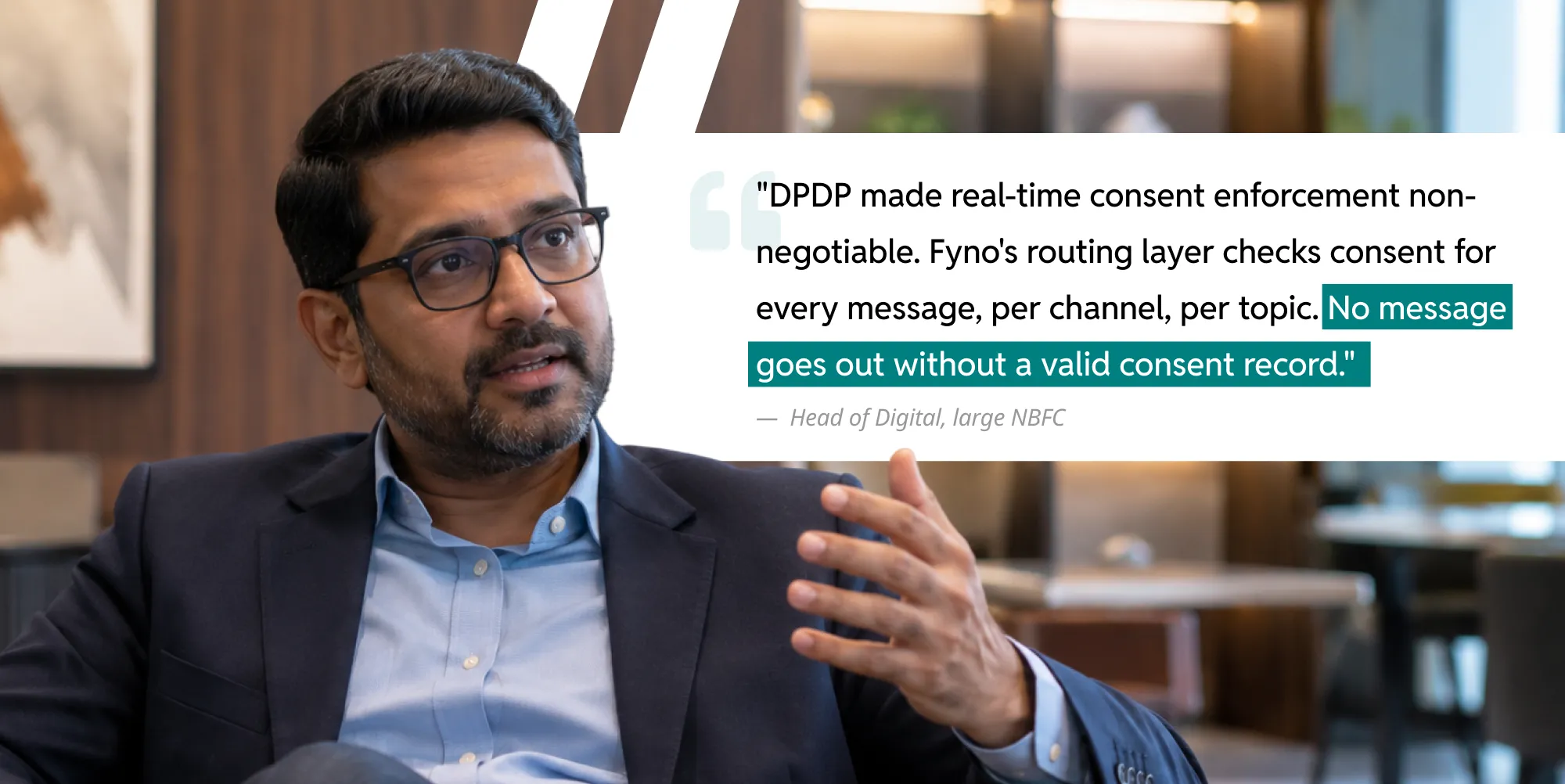
No message gets routed without checking consent status
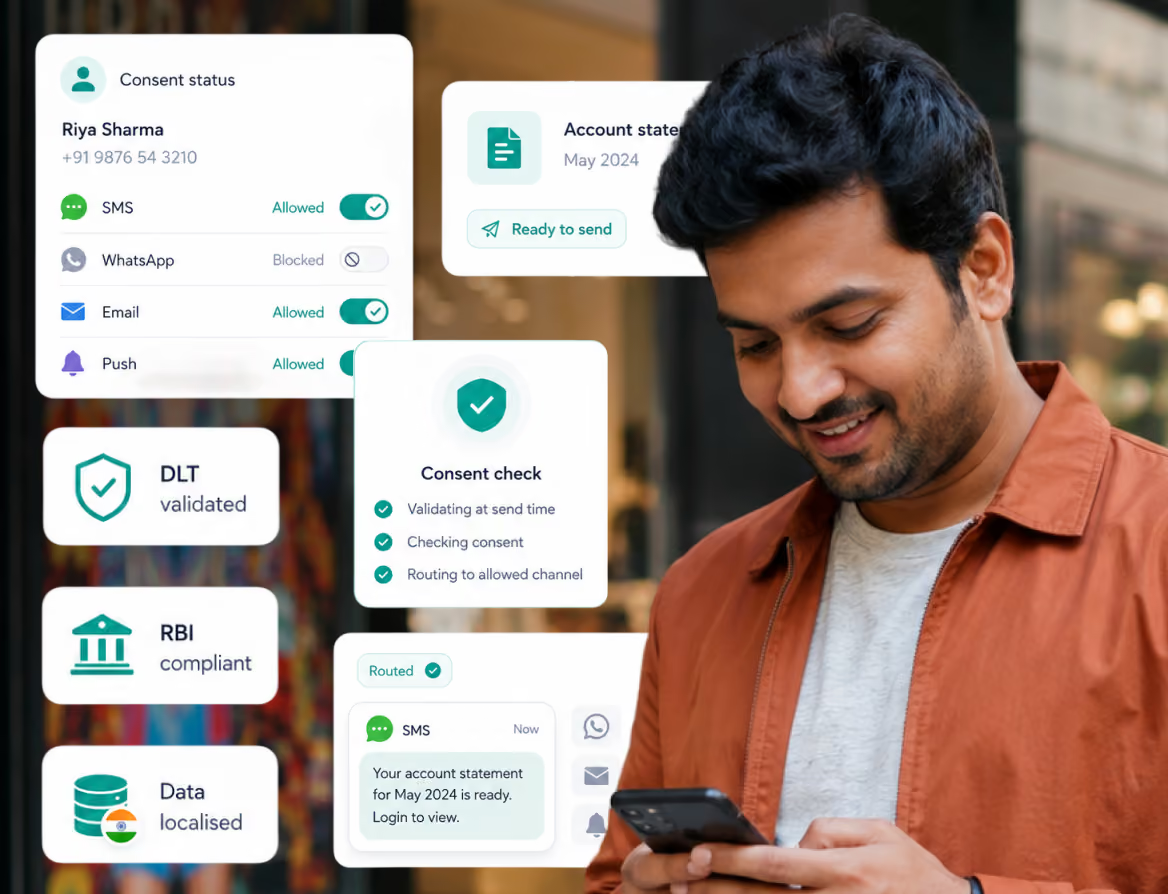
Fyno validates consent, DLT status, and DND at the routing layer just before sending any message, not just while drafting.

.webp)




.svg)
.svg)


.svg)

.webp)

.svg)
.svg)


Consent captured is not consent enforced
ROUTING BASED ON CONSENT
Message routed based on channel & topic preference

CHANNEL ROUTING CONSENT
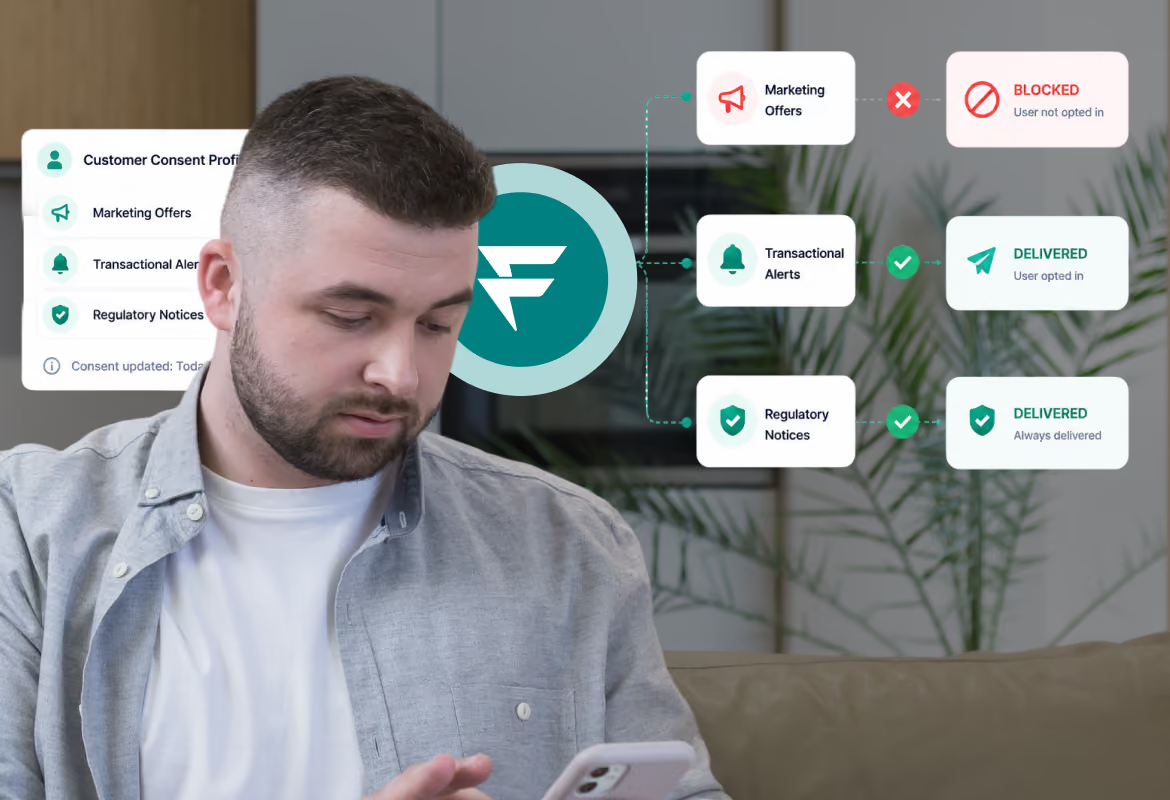
Consent checked per channel
SMS, WhatsApp, email, push, and in-app validated independently against consent records. Fallback to a consented channel when the primary is blocked or the destination is unreachable.
PER-TOPIC CONSENT
Consent matched to topic
Every send checked against topic-level consent: offers, statements, cross-sell, account updates. Regulatory notices delivered regardless of opt-out.
FREQUENCY CAPPING
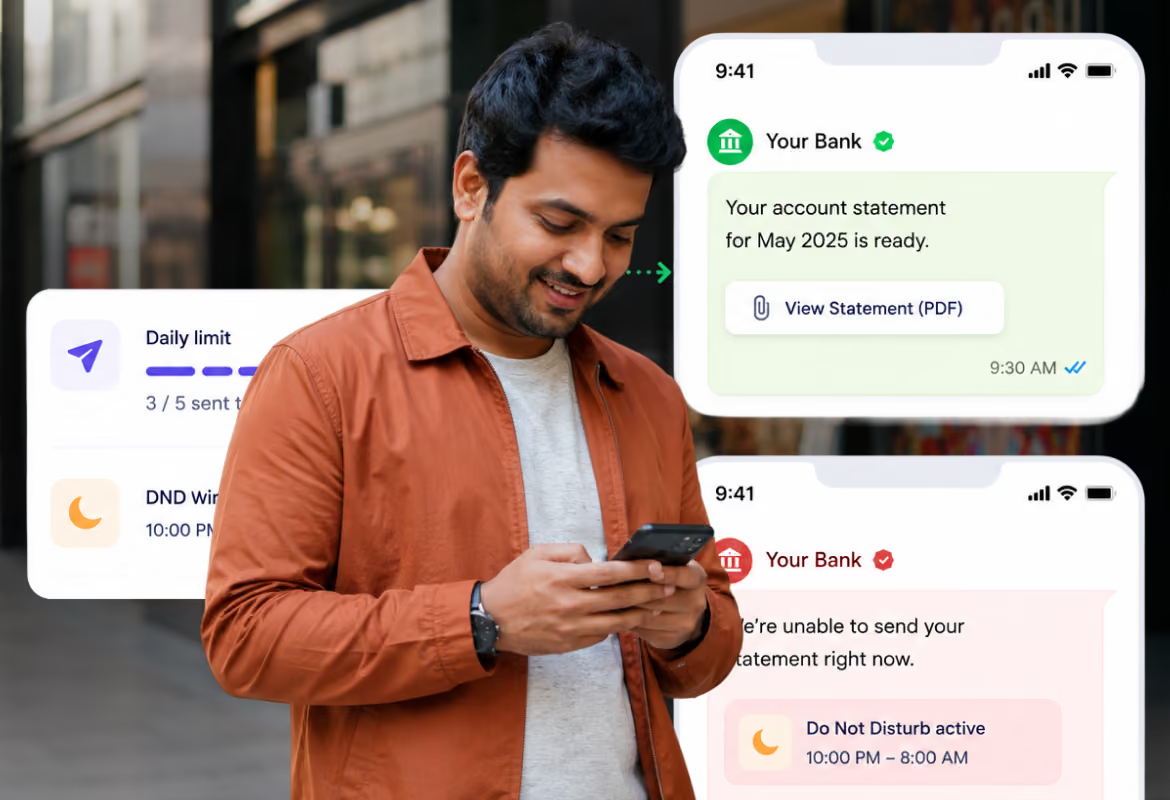
Send limits enforced per user
Per-customer daily and weekly caps checked at every routing decision. DND windows and quiet hours enforced before dispatch. No customer over-messaged.
REAL-TIME SUPPRESSION
Instant block across all vendors
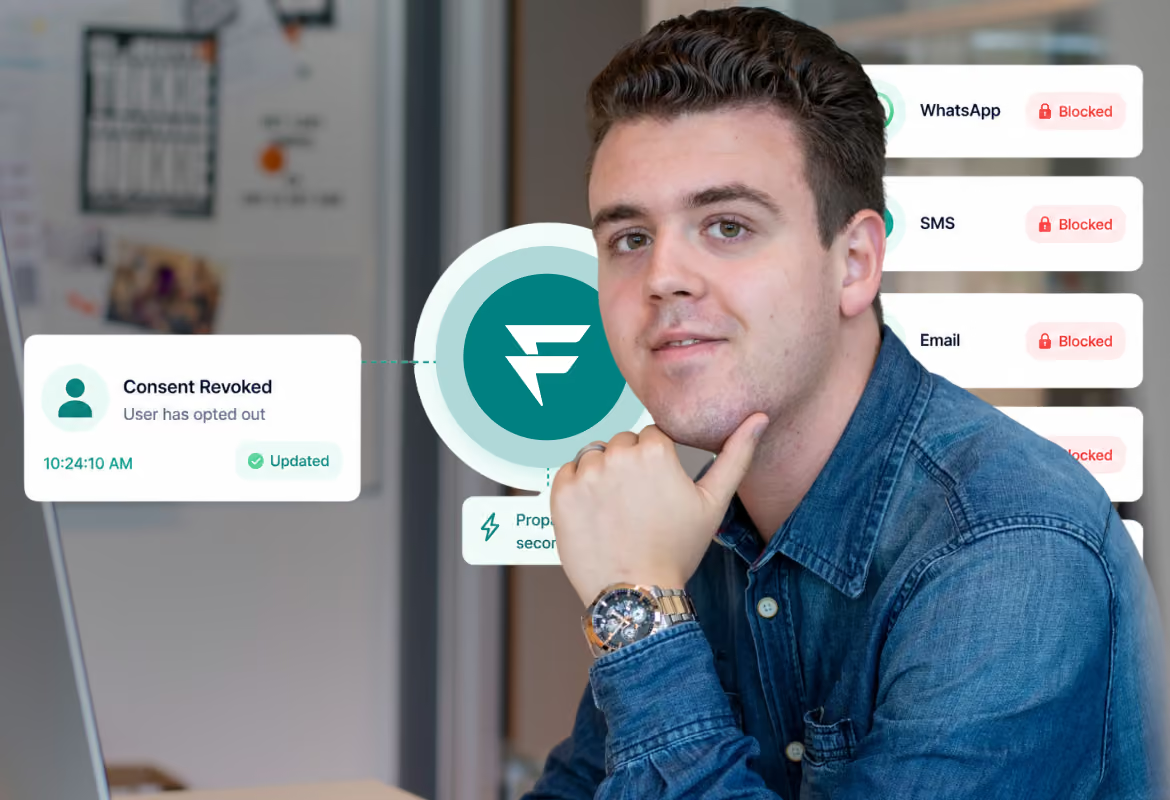
Customer withdraws consent, and every active campaign across every vendor stops within seconds. No stale sends. No compliance gap post opt-out.
Find the answers that you need
The Preference Manager is where customers set their preferences: which channels, which topics, what frequency. Consent-Based Routing is where those preferences are enforced. The Preference Manager captures and stores consent. The routing layer validates it before every send. They work together: preferences flow into the routing engine, and the routing engine blocks any message that does not have valid consent. You need both. Capture without enforcement is a compliance gap: preferences exist in the database but nothing stops a message from being sent through an unconsented channel. Enforcement without capture gives customers no control over how they are reached. The two layers are designed to operate as a single system.
The preference change takes effect immediately at the routing layer. Even if a campaign segment was built an hour ago and the send is in progress, Fyno validates each individual message against the customer's current preference state before dispatch. If the customer opted out of SMS between segment build and send, the SMS is suppressed for that customer. No manual intervention is required from the campaign team. This real-time enforcement is what distinguishes Fyno from systems that check consent only at segmentation or campaign build time. In those systems, a consent withdrawal between segment build and message dispatch creates a compliance gap that is invisible to the campaign creator and difficult to detect in audit.
Every message in Fyno is tagged with a topic: marketing, product updates, regulatory notices, transaction alerts. Before routing, the engine checks whether the customer has active consent for that specific topic on the target channel. If the customer unsubscribed from marketing updates but kept transaction alerts, only the marketing message is blocked. Topics are classified as soft or hard. Soft topics can be unsubscribed by the customer. Hard topics, such as regulatory notices and OTPs, are mandatory and always delivered regardless of preference settings. This enforcement happens at send time, not at campaign build, so that a topic preference change between segment creation and dispatch is respected.
When a campaign sends a message, only the data fields required for that specific send are shared with the delivery vendor. Customer data that is not needed for the message, such as account balances, loan amounts, or Aadhaar numbers, is never exposed to the vendor. The processing layer strips the payload down to the minimum required fields before dispatch. This is enforced automatically at the routing layer, not manually by the campaign creator. For DPDP compliance, purpose limitation is not optional. The Act requires that personal data be processed only for the specific purpose for which consent was given. Fyno's architecture enforces this at the infrastructure level, removing the risk of accidental data exposure through campaign configuration errors.
Under the Digital Personal Data Protection Act, a data fiduciary must obtain consent that is specific to the processing purpose, informed, and freely given. For communications, this means a blanket opt-in is not sufficient. Consent must be tied to a defined purpose: marketing, service updates, regulatory alerts. The fiduciary must also demonstrate that consent was valid at the time the message was sent, not just at the time it was collected. Fyno enforces this by validating purpose-specific consent at every send, linking each message to the consent record that authorised it, and suppressing messages within seconds when consent is withdrawn. The timestamped audit trail provides the evidence a Data Protection Board inquiry requires.
Yes. Fyno sits between your application layer and your delivery vendors. It does not replace your SMS, WhatsApp, or email providers. It adds a consent enforcement and routing layer before the message reaches any vendor. Fyno integrates with all major Indian CPaaS providers and global channels including WhatsApp Business API, FCM, and APNS. When a message is triggered, Fyno validates consent, applies routing logic, selects the optimal vendor based on cost, deliverability, and compliance rules, and dispatches. Your existing vendor contracts and relationships remain intact. If you switch vendors or add new ones, the consent enforcement layer does not change. Fyno adds governance, not another delivery stack.
The full DPDP enforcement deadline is May 13, 2027. Fyno's consent-based routing provides three things DPDP requires: purpose-specific consent validation before every promotional send, timestamped audit records linking each send to the consent that authorised it, and automatic suppression when consent is withdrawn. Building this infrastructure at scale takes longer than most enterprises plan for. Consent must be tracked per purpose, per channel, and per topic. Audit trails must link every send to the consent record that authorised it. Suppression must propagate across all vendors within seconds. The organisations that begin now will have a functioning, audited system by the enforcement date. Those that wait will be rebuilding their communication infrastructure under time pressure.
Discover insights
Learn how teams streamline communication, manage templates, and scale faster with Fyno.


.svg)