

Templates
Think of a template as a master blueprint for your messages. Instead of writing text directly into your code, you design your messages inside Fyno. This means you can change your wording, fix typos, or update branding anytime you want without needing a developer to change code or redeploy the app.
Templates are a one-stop shop for all your message content that needs to be recorded and stored in a safe place within the Fyno App, that can be used when needed.
Be it static or dynamic templates with variable or replaceable parameters for important details and personalisation of messages, we got you covered, as always!
Templates are stored based on the Channel Type as per the Integrations Section. This is the second and crucial step in the Fyno building blocks to create your perfect notification event flow.
Where it fits in your workflow
It sits right in the middle of your core notification setup:
- Connect your provider: Link your communication channels (e.g., Twilio, SendGrid, Gupshup).
- Design your Template: Create and personalize your messaging layouts (This Step!).
- Trigger it: Launch and orchestrate the delivery using a workflow event.
Tip: By decoupling message content from application logic, you can safely experiment, update multi-channel copy, and test variations in real-time without affecting active production features.
Getting Started with Templates
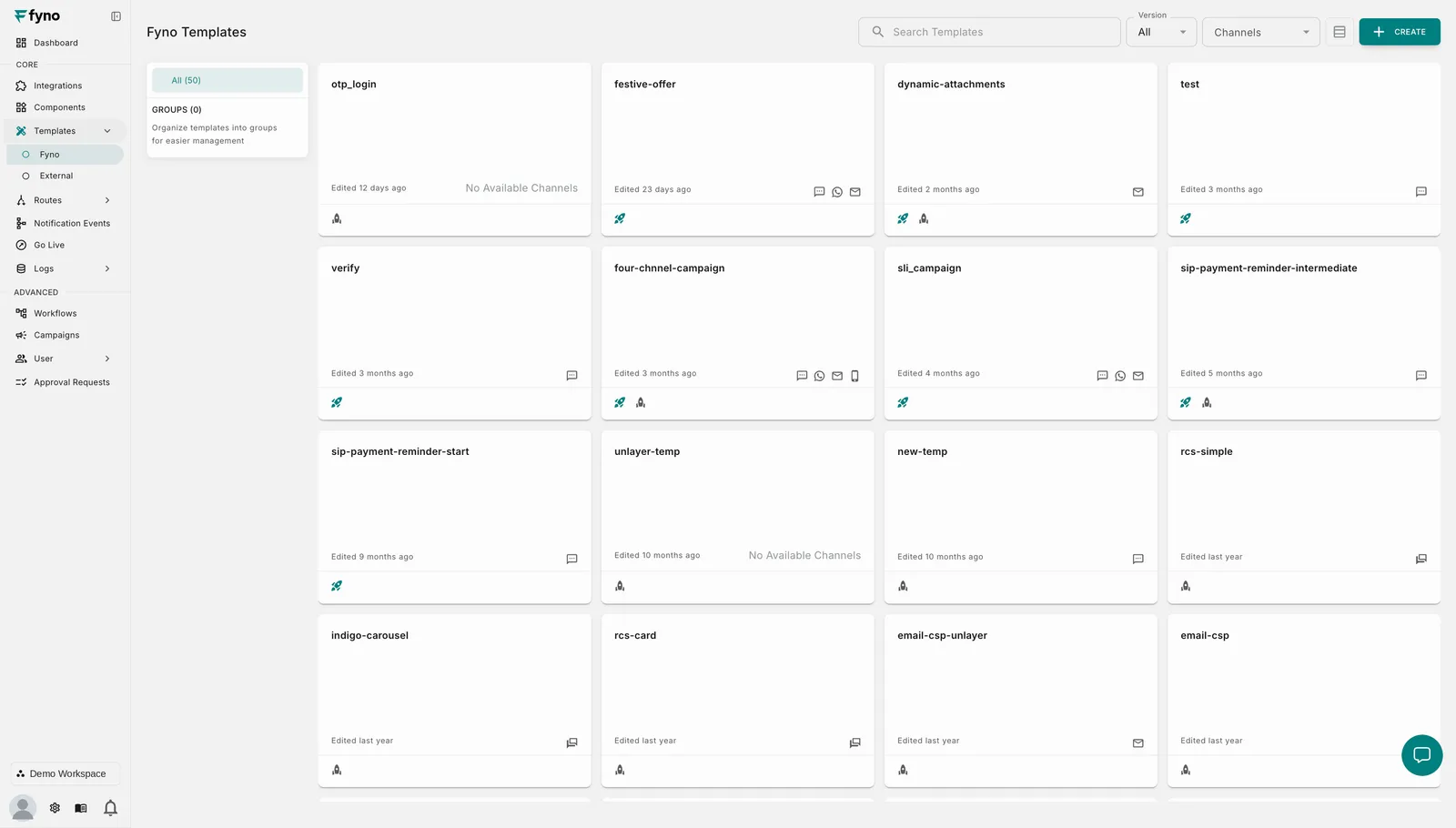
Click Templates in the left navigation. It opens the Templates page, which lists all your templates.
Let’s run through the Templates Page to have a better understanding of how it works.
On the landing page, to the left, you will find an easy toggle to change your view between a card grid and a list view, for your convenience.
Your option to filter out only the Live templates is at the top of the page.
Create
For a full walkthrough of the template editor, see Creating a Template.
Template Collection Cards
On the landing page of the Templates section, you will be able to see all the templates created.
You can also search for templates by entering their names using the search bar at the top of the page.
On each template card, you will see:
- Template Name
- Created time/date.
- The corresponding channels for which templates have been configured within that collection. (Explained more in detail below)
- The “More” (Three dots) menu allows you to:
- Rename your template
- Delete your template
- Promote Test to Live
DLT Templates and Meta Templates
Your SMS and WhatsApp templates that need provider approval have their own pages under Templates:
- DLT Templates for your SMS templates registered on the DLT platform.
- Meta Templates for your WhatsApp templates.
From these pages, you can either create a new template or bring in templates that already exist in your WhatsApp Business account or DLT account. Fyno sends newly created templates to the provider for approval, and once approved they become available to use in Notification Events, Templates, and Workflows. If a template was created directly on WhatsApp or the DLT platform, you can simply sync it to make it appear here. All template actions, such as creating templates, checking their status, and keeping them up to date, can be done from these pages.
Copying Templates
You can copy templates from one workspace to another workspace that you own, making it easy to reuse notification templates across multiple workspaces.
Prerequisite: You must have the Owner role in the destination workspace to use this feature.
Note: Only the templates on the Templates page can be copied. DLT Templates and Meta Templates are not supported.
Before you begin
Only the template itself is copied. Any external dependencies must be resolved or created in the destination workspace before you can use the copied template.
Before copying templates, make sure the destination workspace is ready.
- Create any required integrations in the destination workspace.
- If the template uses reusable components, copy those components to the destination workspace before copying the template. See Copying Components.
Note: Only the template and its associated template data are copied. Dependencies such as integrations and reusable components must exist in the destination workspace.
Steps to copy templates
- Switch to the workspace that contains the template you want to copy.
- Click Templates in the left navigation.
- Locate the template you want to copy.
- Click the Three Dots (⋮) menu on the template.
- Select Copy to another workspace.
- A checkbox appears beside every template in the list. Select one or more templates to copy.
- Click Copy Selected Templates.
- If copying a single template that has a Live version, choose whether to copy the latest Live or Test version. If the template only has a Test version, that version is copied.
- When copying multiple templates, the latest available Live version is copied where available; otherwise, the latest Test version is copied.
- In the Destination Workspace(s) dropdown, select up to five workspaces where you have the Owner role.
- Click Confirm to begin the copy process.
Once the process completes, the selected templates are available in each destination workspace.
How template versioning works
Let’s say we are copying a template from Workspace A to Workspace B. There are two versioning scenarios to keep in mind.
- If the template does not exist in Workspace B, then the version created by the copy process will always be v1 (Test).
- If the template already exists in Workspace B, then the copy process will create a new standalone version (neither test nor live), without modifying existing versions.
Workspace B already has the template at v1 (Test). When you copy the template into it, Fyno creates a new standalone version, v2. To use it:
- Select v2 from the version dropdown next to the template name.
- Choose what to do with it:
- Click Save to make it v2 (Test).
- Click Go Live to promote it to v2 (Live).
This way, existing versions in the destination workspace are never overwritten, and you decide when to save or promote the copied template.